






 Energy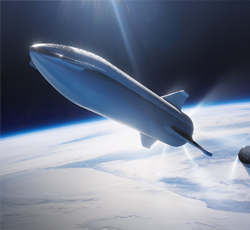





Edited and reviewed by Zoe Gordon
Illustration of the proposed RLV C5. Credit: DLR.
Spaceflight entered a new era the moment a stainless-steel tower the size of a skyscraper lifted off the Texas coast. SpaceX successfully launched its Starship Super Heavy booster and later caught it mid-air with massive mechanical arms on October 13, 2024, during its fifth Starship test flight.
Starship is designed to haul more than 100 metric tons to low Earth orbit while remaining entirely reusable. If SpaceX perfects this system, it will drastically slash the cost of reaching space. The cost of deploying satellites or even space stations would be only a fraction of the staggering expense required today. But what does this mean for the rest of the world? Do other space agencies simply sit idly by and outsource their launches to SpaceX, or do they find a different path to the stars?
Researchers at the German Aerospace Center (DLR) decided to crunch the numbers. They wanted to know exactly what Starship is capable of today, and how Europe might build a sovereign alternative that doesn’t rely on the whims of American billionaires.
Decoding Starship Students make $10,000 satellite with a 3-D printed drag sail that won’t leave any space junk
As a result, an astonishing 74% of the mass the RLV C5 carries to orbit is pure, usable payload.
But how on Earth do you recover the first stage without firing landing engines like a Falcon 9? You give it wings. The SpaceLiner booster burns highly efficient liquid hydrogen and oxygen to push the payload toward space. After separating, the booster glides back down into the atmosphere. Once it slows to subsonic speeds, a large aircraft swoops in, captures the gliding rocket in mid-air, and tows it home.
The DLR researchers have already tested the concept in lab-scale experiments. Because the booster doesn’t need to save fuel for a landing burn, every drop of propellant goes toward launching the payload.
Paper Rockets vs. Flying Giants
The hypothetical-for-now RLV C5 could launch over 70 metric tons (77 US tons) into orbit. It would be vastly smaller than Starship at only a third of its launch weight and likely far cheaper to operate for Earth-centric missions, even if it throws away its upper stage and has to make a new one from scratch for every launch (although that’s a pretty big assumption).
However, we have to acknowledge the elephant in the room. Starship is a real piece of hardware that has streamed through the Texas skies eleven times. It is flying, sometimes breaking, and always improving with every launch.
The RLV C5, on the other hand, exists purely on paper and in computer simulations. The capital investment, institutional knowledge, and pure human effort required to catch up with SpaceX are massive.
But as the global space industry shifts, sovereign access to space is becoming a critical security issue for European nations.
In any event, the researchers make it clear that the RLV C5 isn’t meant to replace Starship, which is designed from the outset for interplanetary missions. Instead, it’s about providing a tailored, highly efficient tool for a specific job. As Moritz Herberhold and his team conclude in their paper: “RLV C5 offers an effective path for Europe to independently develop partially reusable super-heavy launch capabilities.”
Sometimes, competing with a giant doesn’t mean building a bigger giant. It means building something smarter for your exact needs.
Please first to comment



Stay Connected
Tweets by elonmuskTo get the latest tweets please make sure you are logged in on X on this browser.