





 Energy


16:54 EST, 27 February 2026
e-mail This latest expansion of the 'Muskonomy', as Musk's empire is known, underlines the pivotal role that space is set to play in the AI arms race.
But it also underlines the importance of space to terrestrial defence, at a time when Nato countries are pledging to boost spending in this area by 5 per cent to $13.4 trillion (£9.9 trillion) by 2035.
Space firms of every type could seize 10 to 20 per cent of this uplift, thanks to surging expenditure on technologies like earth observation which involves the satellite surveillance of infrastructure and troop movements.
For example, the Azalea satellites, operated by UK defence titan BAE, provide 'intelligence, surveillance and reconnaissance to enhance the nation's ability to protect against modern threats'.
The information coming from satellites is now a key defence capability, according to Mark Boggett, chief executive of the Seraphim Space Fund investment trust. He said: 'Ships and tanks can now be destroyed by drones that cost a few dollars to build. But better technology gives you an advantage over your aggressors.'
About 70 per centof the revenues of the companies in which Seraphim Space invests are derived from defence. These tech stars are switching over their satellites from monitoring projects for insurance and oil firms to the observation of hostile zones on behalf of the US, UK and other Nato states.
Defence is one reason why the S&P Kensho Final Frontiers index, which is made up of space technology companies, has risen by 86 per cent over the past 12 months.
The index's members include armaments and weapons companies like the US giants Boeing, Lockheed Martin and Northrop Grumman, but also names like Planet Labs. This business, set up by three ex-Nasa scientists, operates a fleet of image-taking satellites. Its shares are 409 per cent higher than a year ago.
The creation of X.AI has been described as 'financial engineering' by sceptics. There are also no details yet as to how Musk plans to raise the vast sums of capital to pay for the assembly and launching of the satellites – he would like to have a constellation of one million satellites.
But it would be short-sighted not to see the enterprise, however far-fetched, as an alert to look beyond planet Earth for the next portfolio opportunities. Here's how to plan your voyage into space.
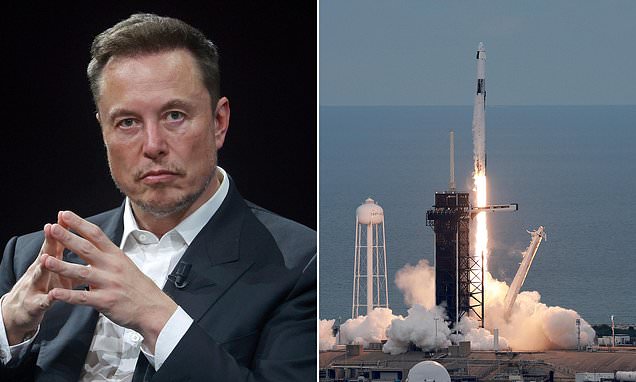
Taking off?: A SpaceX rocket during launch
A STAKE IN SPACEX
The planned stock market debut of X.AI should be 'the healthiest wealth creation event in history', according to Shaun Maguire of the US venture capital firm Sequoia Capital. This is presumably because the wellbeing of the company's workforce will be enhanced by the appreciation in their stock options.
The flotation could also be a massive boost for Musk, SpaceX's largest shareholder with 43 per cent of the company, in his campaign to outpace the other tech billionaires in the AI arms war.
Boggett said: 'The combination of the two businesses will enjoy a moat – a competitive advantage. Data centres are voracious users of energy which is costly. But X.AI's data centres in space will have access to an unlimited source of free energy – from the sun.' Musk may opt to deploy these data centres only for the use of his own ventures, including Tesla, or give access to his rivals for a fee.
THE STAR FUNDS
Musk's extraterrestrial ambitions could also be good news for you if you have money in Scottish Mortgage. This £13.38billion investment trust, managed by Baillie Gifford, invested $200m in SpaceX in 2018. This is now worth $3.3billion. SpaceX is also held by other Baillie Gifford trusts: Baillie Gifford US Growth, Edinburgh Worldwide and Schiehallion.
Despite the promise of X.AI bounty, buying shares in these trusts carries a reasonably large degree of risk right now.
Saba, the hedge fund run by activist investor Boaz Weinstein, still owns 30pc of Edinburgh Worldwide, and is making a third attempt to gain control of the trust. Schiehallion and Scottish Mortgage (where I am an investor) are both a bet on tech innovation of every kind.
Baillie Gifford US Growth backs Amazon, Meta, Nvidia and other Magnificent Seven stocks – Tesla, Alphabet, Microsoft and Apple – to which you may be already exposed. Another trust – RIT Capital Partners – also has a tiny slice of SpaceX. But this trust is also for the more adventurous since unquoted companies account for 30 per cent of the portfolio.
Shares in Seraphim Space have leapt by 155 per cent to 146p over the past year, but the trust does not have a stake in SpaceX, choosing to back start-ups and established companies in every aspect of space infrastructure.
The Finnish tactical satellite maker ICEYE is currently the top holding. The firm will be producing satellites for the German government in a joint venture with that country's armaments leviathan Rheinmetall.
Among Seraphim's other investments is HawkEYE, the US leader in the collection and analysis of radio frequency (RF) data, a service with several military applications.
AST SpaceMobile is another Seraphim investment. This US satellite designer is assembling a mobile network in space that should boost connectivity in poorly covered remote, rural or urban spots. This week Seraphim secured finance from its second venture capital fund from the British Business Bank and the National Security Strategic Investment Fund.
If you wish to explore every aspect of space, other options include two exchange traded funds (ETFs): Ark Capital Space and Defence Innovation and VanEck Space Innovators whose ticker symbol (by which it is known on the stock exchange) is Jedi – after the Star Wars warrior order.
In this fund's portfolio you will find Planet Labs and Rocket Lab, a US spacecraft manufacturer which is seen as a mini-SpaceX.
Please first to comment


Stay Connected
Tweets by elonmuskTo get the latest tweets please make sure you are logged in on X on this browser.