






 Energy




>
Science
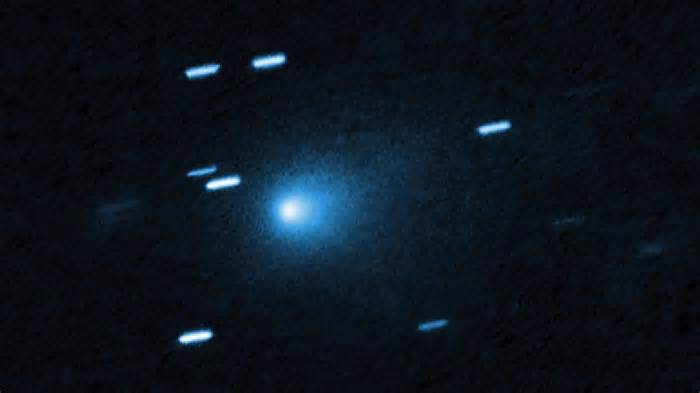
NASA's Hubble Space Telescope has taken the clearest image ever of the interstellar comet, 3I/ATLAS, offering new insights into this rare visitor from another star system. Discovered on July 1 by the NASA-funded Asteroid Terrestrial-impact Last Alert System (ATLAS) at the University of Hawai'i, the comet is speeding through our solar system at an astonishing 2,09,214 km per hour — the fastest recorded velocity for any solar system visitor.
Using Hubble's sharp vision, astronomers estimated the comet's icy nucleus to be no larger than 5.6 km across, though it could be as small as 1,000 feet. While the nucleus itself remains hidden from direct view, even by Hubble, the images revealed a dust plume ejected from the comet's sun-warmed side and a faint dust tail streaming away.
Go, Comet 3I/ATLAS, go! ☄️
Hurtling at a whopping 130,000 miles per hour, this comet has the highest velocity ever recorded for a solar system visitor.
Hubble observations allow astronomers to more accurately estimate the comet's size: https://t.co/s5XkgJcWkF pic.twitter.com/3MihzFCXVx — Hubble (@NASAHubble) August 7, 2025 ALSO SEE: World's Largest Digital Camera Snapped Interstellar Comet 10 Days Before Its Detection; Watch
The dust loss is similar to that of comets from our solar system detected about 482.8 million km from the Sun. "This latest interstellar tourist is one of a previously undetected population of objects bursting onto the scene that will gradually emerge," David Jewitt, science team leader for Hubble observations from the University of California, said in a statement.
Unlike comets born in our solar system, 3I/ATLAS hails from an unknown star system in the Milky Way. Its incredible speed suggests it has been drifting through interstellar space for billions of years, gaining momentum from the gravitational pull of countless stars and nebulae. "No one knows where the comet came from. It’s like glimpsing a rifle bullet for a thousandth of a second. You can't project that back with any accuracy to figure out where it started on its path," Jewitt said.
Multiple NASA missions, including the James Webb Space Telescope, TESS, and the Neil Gehrels Swift Observatory, along with the W.M. Keck Observatory, are studying the comet to learn more about its size and chemical composition. These observations will refine our understanding of interstellar objects. While 3I/ATLAS poses no threat to Earth, it will remain visible to ground-based telescopes until September 2025, before passing too close to the Sun. It is expected to reappear in early December.
Please first to comment




Stay Connected
Tweets by elonmuskTo get the latest tweets please make sure you are logged in on X on this browser.