






 Energy




Print
Amid a string of setbacks for clean energy — tariffs, the Trump administration, Tesla’s declining sales numbers — California officials delivered a big win last month, approving the nation’s largest solar-plus-storage project.
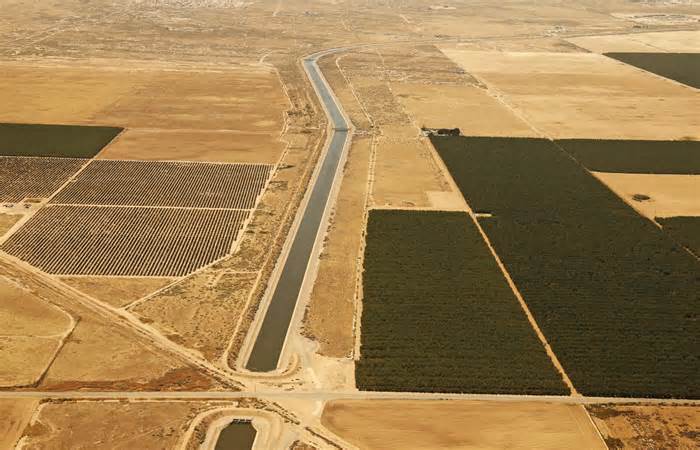
Planned for 14 square miles in Fresno County, the project will provide up to 1,150 megawatts of solar energy and 4,600 megawatts-hours of battery storage. Dubbed the Darden project, it should be able to power 850,000 homes after dark. The developer, Intersect Power, will pay hundreds of millions of dollars in property taxes over time.
And because Darden will be built on retired farmland in an area running low on water, rather than pristine public lands in the desert, there are few environmental conflicts. No Joshua trees to chop down or endangered tortoises to displace. An easy place to build renewable energy and slow the climate crisis.
Advertisement A smoldering home during the Eaton fire on Jan. 8.
(Gina Ferazzi / Los Angeles Times)
The details of AB 1156 are complicated, but the results would be simple.
Across California, 16 million acres — about half the state’s farms and ranches — are protected by the Williamson Act. The 1965 law offers lower property taxes for landowners who agree to keep their holdings in agricultural use or open space. For a grower to renege on a Williamson Act contract — for instance, if they want to sell to a home developer — they have to pay a big fee, or else wait out the duration of their contract.
It’s a good deal for farmers — and, historically, a good way to prevent suburban sprawl.
The problem arises when a solar company finds a farmer who wants to stop cultivating some or all of their lands, but those lands still have years remaining on a Williamson Act contract. Solar companies work on thin margins, and Williamson Act cancellation fees can derail otherwise viable projects. That’s especially true now that Congress and President Trump have eviscerated federal incentives for renewable energy.
AB 1156 would let growers in water-stressed areas suspend their contracts to enable solar development, without anyone paying the fee. The solar company would pay full property taxes. Local officials would need to sign off.
And again: If less water inevitably means lost farmland, why not incentivize solar?
“You’re going to be restoring revenue to not only the landowner, but also to the local economy,” Eddy said.
Conservation activist Kim Delfino, president of consulting firm Earth Advocacy, often finds herself at loggerheads with the solar industry over large-scale projects in the desert. But she and one of her clients, the advocacy group Defenders of Wildlife, support AB 1156 — even though there are burrowing owls and a handful of other sensitive critters that have come to depend on agricultural lands.
Advertisement
“There’s no free lunch,” Delfino told me. “Anytime you put a project somewhere, it’s probably going to have some kind of environmental or habitat impacts.”
And that’s the crux of the challenge: There are lots of reasons to say no to clean energy in your community, even as we all collectively need it. Change is hard. It’s no surprise that farmers embracing solar are being drowned out by their neighbors who want to preserve agrarian communities as they’ve existed for a century.
Farmworkers weed rows of romaine lettuce outside Holtville, Calif., in the Imperial Valley.
(Carolyn Cole / Los Angeles Times)
If California wants to soften opposition to solar, it should try to support farmworkers who see solar as a threat to their livelihoods — even if climate-driven water shortages would have threatened their jobs regardless.
Dustin Mulvaney, an environmental studies professor at San José State, recently co-wrote a paper on solar and environmental justice in the Imperial Valley. He said state officials should require solar companies to pay for more “community benefits” to make up for lost jobs, but not such high fees that companies stop building.
“It’s not a huge, profitable industry. They struggle,” Mulvaney acknowledged.
It’s hard to know what the future holds for Imperial County, which already has 13,000 acres of solar on farmland. The county supervisors are responsible for approving solar projects, not the irrigation district.
Advertisement
Here’s hoping the supervisors recognize that some change is inevitable. Even if they don’t approve every project, they could prod developers toward marginal farmland with lower-quality soil.
In the Central Valley, conditions are more likely to hinge on AB 1156, which passed the Assembly last month and is moving through the Senate. Lawmakers should send it to Gov. Gavin Newsom despite opposition from the farm bureau and other agricultural groups that are demanding amendments.
The farm bureau has argued that letting landowners out of their Williamson Act contracts except under extremely narrow circumstances would be unfair. Were it not for the climate crisis, that argument might have merit.
The thing is, there is a climate crisis. California should act like it.
This is the latest edition of Boiling Point, a newsletter about climate change and the environment in the American West. Sign up here to get it in your inbox. And listen to our Boiling Point podcast here.
For more climate and environment news, follow @Sammy_Roth on X and @sammyroth.bsky.social on Bluesky.
Please first to comment



Stay Connected
Tweets by elonmuskTo get the latest tweets please make sure you are logged in on X on this browser.