





 Energy



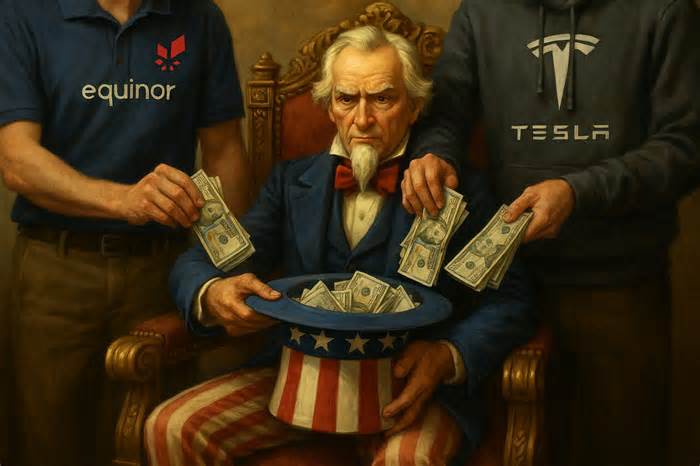
Image art by Paul Gerke via ChatGPT-4o.
In the build-up to last November’s U.S. presidential election, clean energy watchdogs sounded alarm after alarm, warning that another Donald Trump stint in office would imperil not only ambitious carbon reduction initiatives but grid reliability itself. Despite touting a pledge of ‘energy dominance,’ contradictory talk of stifling solar and wind projects in favor of fossil fuel interests and promises to repeal the Inflation Reduction Act and roll back its tax credit provisions sowed seeds of doubt throughout the energy industry.
Now, some of the big boys are reaping. Offshore wind developer Equinor and battery and electric vehicle (EV) maker Tesla are among companies feeling the pinch of poor policy, and they’re far from alone. New E2 analysis indicates more than $22 billion in clean energy projects were scrapped in the first half of 2025; more than $6.7 billion just in June.
“By effectively ending clean energy incentives, Congress is turning its back on thousands of American workers and dozens of communities that were ready to build our energy future and strengthen America’s competitiveness,” stated E2’s Michael Timberlake, who has tracked 16,500 American jobs lost so far this year. “These cancellations aren’t just numbers on a balance book. They’re jobs, paychecks, and opportunities in communities that were counting on these clean energy projects to drive economic growth. And now they’re gone.”
Equinor Claims $955M Impairment for US Offshore Projects
Norwegian-owned Equinor cited a nearly $1 billion impairment charge in its latest financial report, blaming the now nearly dead-in-the-water U.S. offshore wind industry. The $955 million impairment includes $763 million tied up in Equinor’s Empire Wind 1 project and the accompanying South Brooklyn Marine Terminal (SBMT), plus another $192 million for the company’s undeveloped Empire Wind 2 lease.
“The offshore wind industry is facing major financial and regulatory challenges in the US,” reads part of Equinor’s Q2 2025 report. “Regulatory changes and increased exposure to tariffs impacted the project economics negatively in the second quarter 2025.”
Empire Wind 1, located southeast of Long Island, New York, is currently under construction, despite an unlawful pause this spring following attempts from the Trump administration to cease activities on the fully permitted project. Equinor claims that the 810 megawatt (MW) endeavor is still on track to complete offshore installation this year and begin commercial operations in 2027. In its Q2 2025 report, the company says the value of the lease for Empire Wind II is greatly diminished, since the project will not proceed any time soon. This also devalues the SMBT, since Equinor planned to use it to bring power from at least one Empire Wind expansion to shore, a reality that now appears “unlikely,” per the company.
Equinor broke ground on the South Brooklyn Marine Terminal in June 2024. Courtesy: Tiger Stripe Media
“Without investment tax credits and without a government that wants it to happen, we are not going to invest in it,” CFO Togrim Reitan told investors, referencing the federal budget passed earlier this month that cut off the runway for tax credits for wind projects.
Empire Wind 1 will still be able to take full advantage of tax credit eligibility, but tariffs on critical building materials like steel would make further development much more costly without any federal kickback, completely sabotaging any economic viability. Ironically, Equinor won the offshore lease auction for Empire Wind 1’s location during Trump’s first presidency, in 2017. Final approvals for the project were issued in February 2024.
Tesla Takes it on the Nose
Offshore wind developers aren’t the only players in the U.S. cleantech space taking a beating as a result of President Trump’s anti-energy stances. Even the Commander-in-Chief’s former best buddy and infomercial partner, Elon Musk, is seeing profits imperiled by policy decisions.
On Wednesday, Tesla reported a double-digit dip in adjusted earnings for the second quarter, following a record decline in sales over that span. The company claimed a top and bottom line miss in Q2 2025, primarily due to a 16% year-over-year decline in automotive revenue to $16.7 billion.
Blame it on Musk’s political dalliance, his erratic behavior, other interests, or whatever; There’s no help on the horizon. In October, a long-running $7,500 tax credit for purchasing new electric vehicles (EVs) will disappear, courtesy of Trump’s long-ballyhooed bill. Plus, Trump tariffs promise to make battery components more expensive, further squashing already thin margins for the EV giant.
Tesla sales have been declining even in markets where EV sales are rising overall, and it looks like Musk’s pride and joy is dropping its title of world’s largest EV maker to BYD, a Chinese car company, which isn’t allowed to sell in the United States because the cost to quality ratio of its cars would crush the American market overnight.
Plus, as CNN Business points out, perhaps the most serious financial issue facing Tesla is the elimination of the market for regulatory credit sales, which added $11 billion to the company’s bottom line since 2019. Tesla would have lost money in the first three months of the year without its revenue from selling those credits, which allowed gas-powered carmakers to buy emissions credits from EV makers. The budget bill removed financial penalties for automakers violating emissions rules, so Elon loses out on the revenue stream, and we lose out on air quality regulation. Not exactly a fair trade, but you reap what you sow.
Please first to comment



Stay Connected
Tweets by elonmuskTo get the latest tweets please make sure you are logged in on X on this browser.