






 Energy




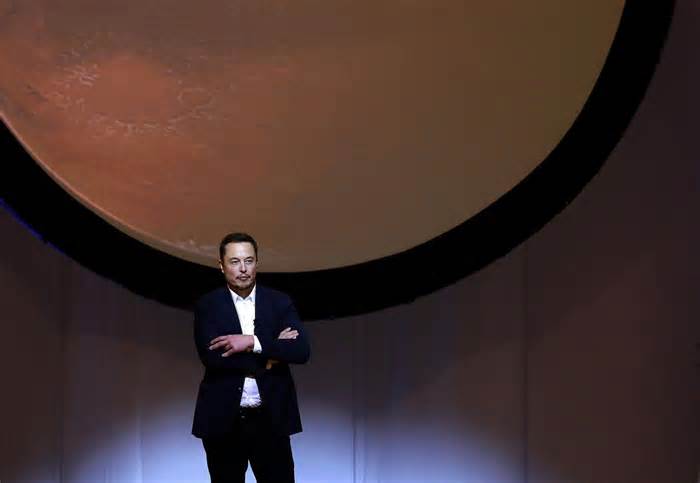
Is Elon Musk the Right Man for Mars?
Still, the boat-load of baggage that follows Musk around makes it prudent to wonder if he is truly the best person to lead us to another planet for the first time in thousands of years of human history.
If you believe in democratic systems stewarded by devoted civil servants, there’s plenty to suggest he’s not the right man. This feeling doesn’t have to be rooted in any of his most high-profile political antics of late; look instead to less politicized moments like one in particular in late 2020 when he gave the order to launch a Starship prototype without final safety approvals from the FAA. This led to a delay of the next test flight and an odd resolution between the company and the regulator that was not publicly disclosed but amounts to a slap on the wrist.
TOPSHOT - A person looks on as SpaceX's huge Super Heavy-Starship is unstacked from the booster as
... More
it sits on the launchpad at Starbase in Boca Chica, Texas, on November 16, 2023, ahead of its second test flight posponed to November 18. The US Federal Aviation Administration (FAA) on November 15, 2023 authorized SpaceX to carry out its second launch of Starship, the most powerful rocket ever built, after a first attempt in April ended in a spectacular explosion. (Photo by TIMOTHY A. CLARY / AFP) (Photo by TIMOTHY A. CLARY/AFP via Getty Images)
AFP via Getty Images
Musk has clashed with regulators in numerous ways over the years and leveled criticisms of outdated bureaucracy that may be justified and surely inform his later efforts at DOGE. Nonetheless, the way Musk chooses to fight back against bureaucratic bloat often seems to many to be hubristic and reckless.
Not exactly the top qualities desired for leading a societal experiment on a new and dangerous planet.
And yet, it is hard to argue with the results he has produced at the helm of SpaceX. While behind on his own aspirational timelines, the development of Starship and the family of reusable workhorse Falcon rockets like Falcon 9 and Falcon Heavy has run circles around NASA’s contractors and revolutionized the space industry.
It’s uncomfortable to admit, but while many argue Musk is not suited for any role near governance and civil society, he might be the best if not the only person realistically able to provide us with the transportation to another world in this generation. And this is a journey worth undertaking.
Why Mars is Worth the Trip
Musk’s central argument that we need Mars as a sort of lifeboat for humanity is not particularly a strong one, especially in the short term. Even if humanity is in the process of actively making Earth uninhabitable, as some of the more extreme activists argue, and at the same time we were to begin actively terraforming Mars to be more habitable, it will still be centuries (if it is even possible at all) before any rational life form might prefer life on Mars. And yes, I’m including even worst-case scenarios like fallout from nuclear war on Earth.
A research station on planet Mars
getty
Still, going to Mars is worthwhile because of the many technological breakthroughs that will likely result in order to achieve the goal, and the dividends that those advancements will pay on Earth to improve well being for all of us. I’ve often cited how the original space race between the U.S. and Soviet Union gave us a number of innovations; just one of these is the satellite revolution that now underpins our entire globalized society of instantaneous communications and data transport, sharing and availability.
This alone is a strong reason to root for Musk to succeed, despite how so many of his other actions can leave one’s neck sore from repeated head-shaking.
And there is a stronger argument for supporting the vision of a multiplanetary species over the very long term, likely well beyond our lifespans. Mars may never be another Earth, but the idea of an escape hatch or a pressure valve for our planet is logical.
We frequently hear the argument that it doesn’t make sense to build on another planet and inevitably ruin it as humans have done to the Earth. Or the cousin to this argument — that the resources would be better spent preserving Earth. But the logic fails, because being truly multiplanetary in the Muskian vision would actually take pressure off of Earth’s ecosystems and, again, innovation driven through space exploration is also likely to bolster sustainability on Earth. Not to mention that diverting the resources currently going toward Starship development and using them for environmental restoration is a gross oversimplification of how capital allocation actually works.
WASHINGTON, DC - MAY 9: Jeff Bezos, founder of Amazon, Blue Origin and owner of The Washington Post
... More
via Getty Images, introduces the newly developed lunar lander "Blue Moon" and gives an update on Blue Origin and the progress and vision of going to space to benefit Earth at the Walter E. Washington Convention Center. (Photo by Jonathan Newton / The Washington Post via Getty Images)
The Washington Post via Getty Images
Jeff Bezos’ Blue Origin actually has a very inspirational vision for how space exploration could benefit Earth by moving much of heavy industry off the planet and preserving Earth as a “garden planet.”
The point is, you may not like Musk for a number of reasons, but the notion of humans expanding beyond our home planet is not his novel idea and it’s not a bad one. It may actually be a necessary one.
It comes down to what you think about humans. On balance, are we a destructive or constructive species? Is the pre-industrial medieval world preferable to the globalized, modern mixed bag of today? There’s an interesting discussion to be had there, but the answer to me is a pretty obvious no, and I’m interested to go farther. Perhaps with Musk.
But when it comes to Mars, I draw more inspiration from the vision of a planetary scientist named John Lewis, who was at the University of Arizona and whom I saw speak over a decade ago. He posed a simple question: if you think the modern society we have built is at all interesting or impressive, just imagine what a few quadrillion humans spread out across the solar system can accomplish.
Please first to comment



Stay Connected
Tweets by elonmuskTo get the latest tweets please make sure you are logged in on X on this browser.